- What are Rights of Way?
- How do you know if a path is a right of way?
- What are all the different waymarks we see?
- Why don’t you replace stiles with gates?
- Why don’t you always install dog gates?
- How do you balance improving drainage on a path with slowing the flow?
- How do you balance cutting back overgrown vegetation with protecting nature?
What are Rights of Way?

We operate under the Countryside and Rights of Way Act 2000 and we maintain and repair the Rights of Way and permissive path network in the Upper Calder Valley and Ryburn Valleys. Signage is an important part of our work to ensure path users can keep safely to the designated pathway. We maintain existing waymark signs and install new ones where necessary.
How do we know if a path is a ‘right of way’?

To find out if a path is an existing Right of Way you can go to Calderdale Councils Leisure and Culture Map. Scroll to the “Legend” and tick the box beside “Rights of Way”. You will then see all the Rights of Way appear as dashed lines in purple for footpaths and in green for bridleways.
At first the view is zoomed out to the whole of Calderdale, but you can zoom in to a very detailed map. Click and drag the map to see the area you are interested in. Click on a footpath and a popup window will show the official footpath number. This is the definitive map of Rights of Way – the Ordnance Survey maps also show Rights of Way, but they may be out of date and therefore slightly different.
What are all the different Waymarks we see?
Public Footpaths (Rights of Way)
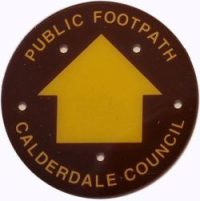
Yellow arrows are used to waymark public footpaths. You can travel along these on foot or using your mobility aid (e.g. prams, pushchairs, mobility vehicles like wheelchairs). Do plan the route first to see if this is possible; you may come across stiles, kissing gates or narrow gap stiles which may be difficult to negotiate.
Bridleways
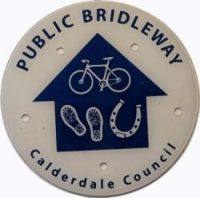
Blue arrows are used for Bridleways. These routes are for the use of Horse Riders and Cyclists and are generally stile free, wide and have clear headroom. They are also open for walkers, mobility scooters, and wheelchairs. Though they are wider, always keep an eye open for other users to maintain safety.
Permissive Paths

Permissive paths are not Rights of Way. They are open to use because the person who owns the land has made the route available to the public. There is no standard waymark but there should be a notice at the start of the path to explain that it is permissive and outlining the conditions of use. A Permissive Path may be marked on an Ordnance Survey map and if it is, it will be with a line of orange/brown dashes.
Designated Long Distance Walks , and local walking routes.

We have many long-distance footpaths in our area, e.g. The Pennine Way, Pennine Bridleway, Calderdale Way, Burnley Way, Rochdale Way, and Todmorden Centenary Way. They all have their own individualised waymark. National Trails are marked with an acorn for example.
There may also be special waymarks for local walking routes published by groups. e.g Making Tracks.
For a wide selection go to 100 Walks in the Heart of the Pennines
Why don’t you replace Stiles with Gates?

Replacing a wooden stile with a gate may be possible. However, to do this we need the landowner’s permission. They may be reluctant to give this because of the danger of the gate being left open and livestock escaping.
Many of the old walls in our area incorporate gap stiles, squeeze stiles or stone-step stiles. Fitting gates into these often presents serious (and potentially expensive) technical difficulties.
Why don’t you always install Dog Gates?

The installation of specific Dog Gates (small, latched openings at the bottom of the stile) is discretionary for landowners in the UK. Landowners are not legally required to provide dog specific access points to the stiles.
We can only add a new dog gate to a stile if it is authorised by Calderdale Council Highways, or we have the landowner’s permission. When we are rebuilding a stile, we always try to find the landowner and ask about dog gates, but some are reluctant to give permission. We do now install wider tread boards that make it easier for many dogs to negotiate a stile.
How do you balance improving drainage on a path with slowing the flow?

Our aim is to make a path usable by directing excess water from the surface of the path. This often involves digging a drainage channel alongside the pathway to divert the water away. This means that a boggy area is created just off the path which slows the flow.
Where a bog area is ecologically important, we can install a boardwalk (anchored by posts), so walkers are kept on a dedicated route and do not damage sensitive flora or erode the bog.
How do you balance cutting back overgrown vegetation with protecting nature?

Footpaths allow people to enjoy the countryside, but for this to succeed the path must be usable and safe. Before starting a cutting back job we walk out the path looking for nests or rare plants which may need special consideration.
We then cut back any vegetation that obstructs a path but try to preserve plants growing near the edges of the path. It is often a fine balance between access to a right of way and consideration of nature.