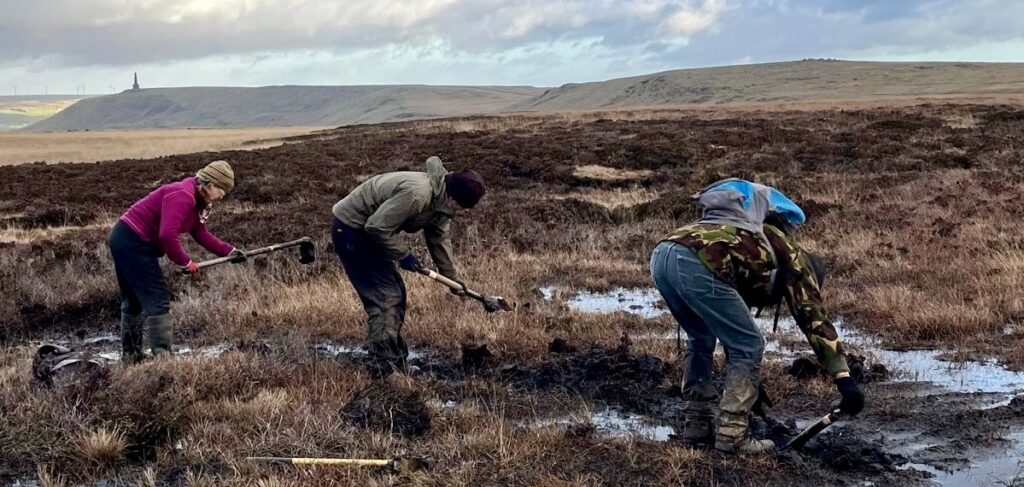
Every job has to be surveyed. The work starts with collecting the necessary tools and materials and getting them and us to the site.
Cutting back vegetation
Overgrown vegetation can block a footpath. We clear this with shears, hedge cutters, saws, loppers, strimmers and brush-cutters.
Occasionally we need a chainsaw to clear fallen trees.
Himalayan Balsam is a problem. We clear any that encroaches on paths, but for other locations see our balsam guide.
Improving drainage
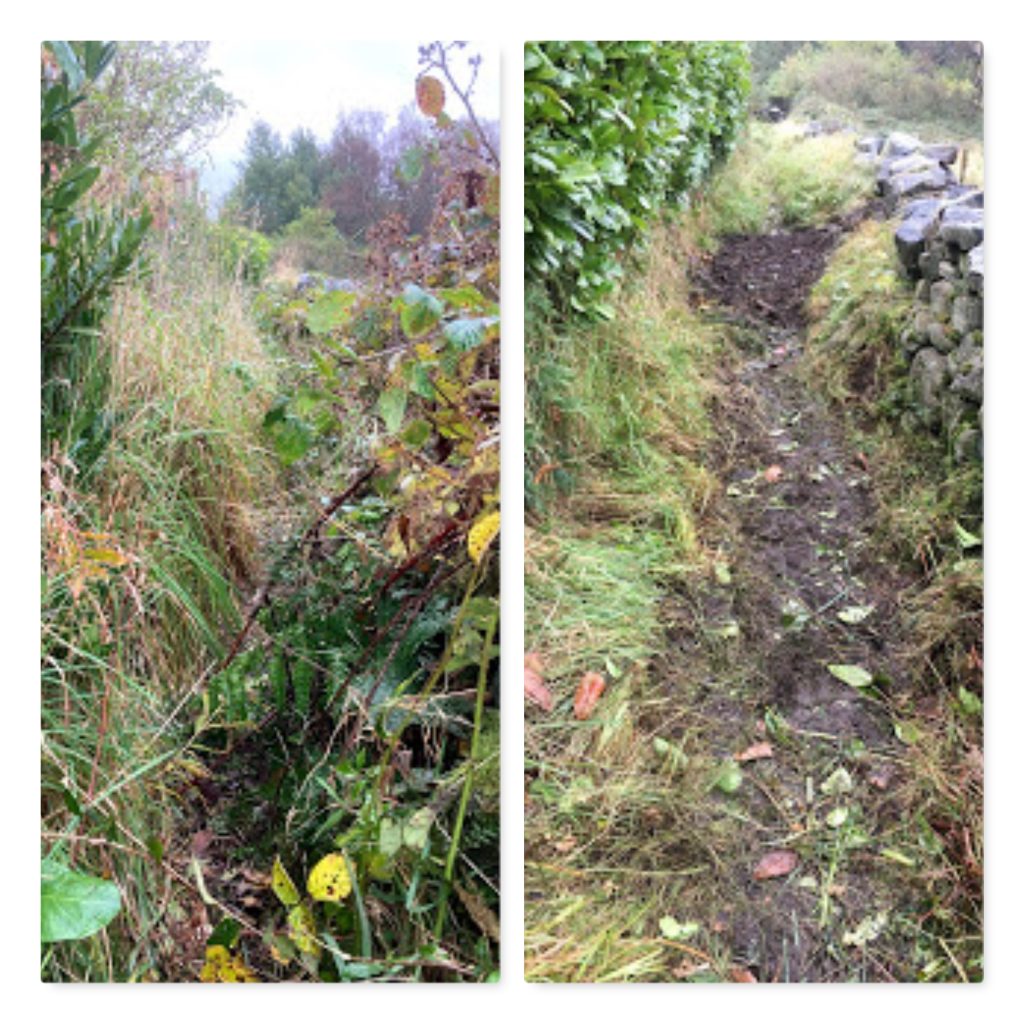
A path may be muddy or clogged with leaf mould which we scrape off. Where water is running over the path we divert it into ditches and drains. Azads, spades, shovels and mattocks are the tools for this work.
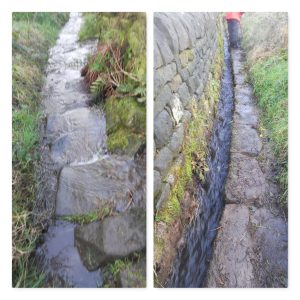
This shows a drain cleared out alongside an old causey path.
Widening and improving path surfaces
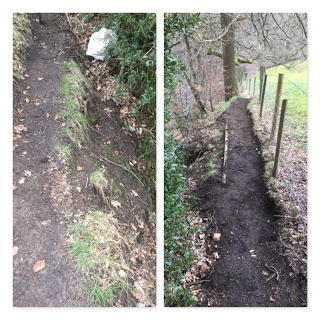
Paths can get very narrow and difficult. Widening a path involves using azads, spades and mattocks. On steep hillsides paths can become unstable, so we put in a wooden revetment to hold up the edge. A favourite job is uncovering ancient causey stones that have been covered by grass.
This path is above Sandy Brook at Barkisland.
Repairing stiles and gates
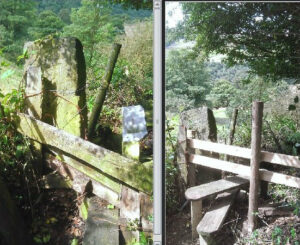
Many stiles were built more than 20 years ago, and the Pennine weather and livestock have taken their toll.
New tread boards, new uprights and new rails are often needed. We use hammers, saws, drills and other carpentry tools on these jobs.
This impassable stile was on a path below Burlees Lane, Hebden Bridge.
Constructing and repairing steps
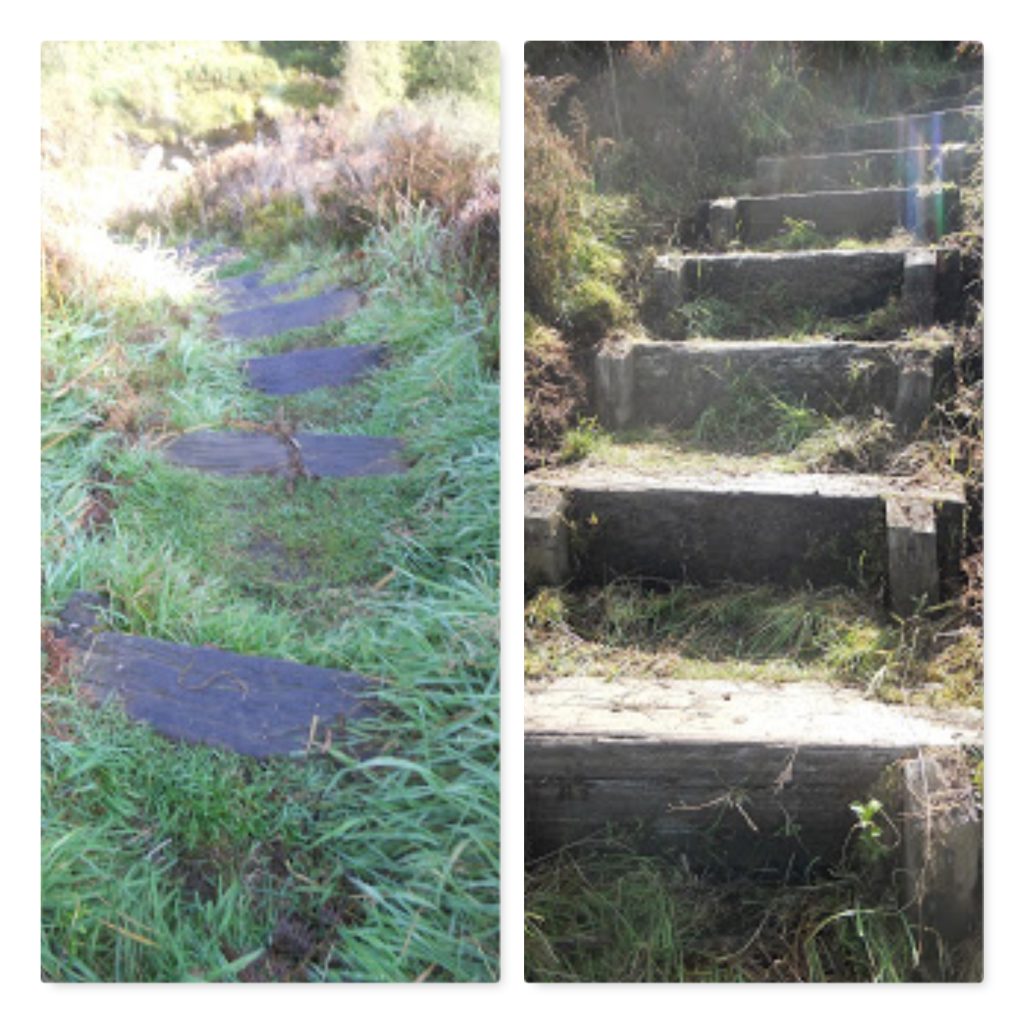
Old stone steps can become overgrown and need clearing, and wooden steps eventually rot. Over time slopes can become eroded and very slippery.
One way of dealing with this is to install new steps. We use hammers, saws, drills, other carpentry tools and the heavy bar on these jobs.
Constructing and repairing boardwalks
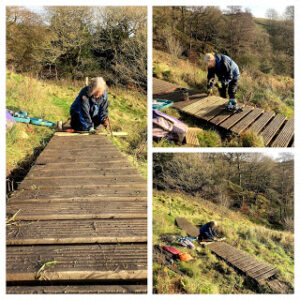
Boardwalks get people across marshy ground where we can’t channel the water away from the path. Eventually these need repairing – usually to replace rotten or broken slats.
Sometimes we add staples to the boards to give people a better grip. The boardwalk is firmly fixed to the the ground by long stobs often hidden under the cross-treads.
This boardwalk is above Mytholmroyd.
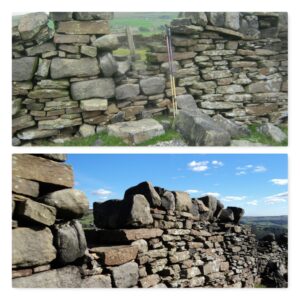
Repairing stone walls
Wall repairs are sometimes needed where there is some kind of stile. Walls start to disintegrate where sheep climb over or where the stile is used a lot.
Hammers and stone chisels are the main tools, but more importantly we need our two experienced wall builders, as they have the eye for the right stone in the right place.
This wall is at Shackleton above Hardcastle Crags.
Constructing and repairing bridges
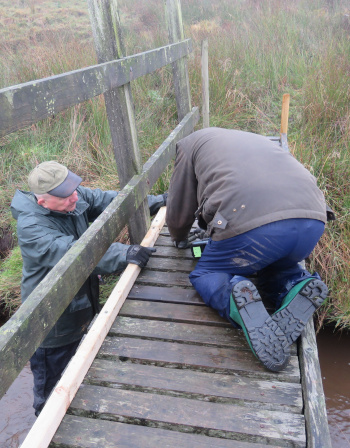
Wooden bridges face the same problem as boardwalks with rotten or broken slats. Occasionally we have to rebuild a bridge if the main beams have broken.
For this work we use hammers, nails and staples. We secure the bridge to the ground on each bank of the stream by driving long pegs into the ground with a heavy steel bar.
This bridge crosses Hippins Clough at Blackshawhead.
Waymarking
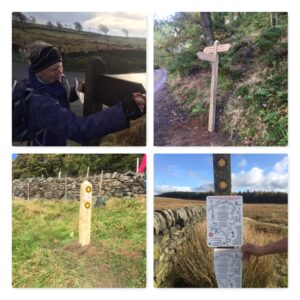
More people are walking without maps and rely on waymarks – “The reassurance of the little yellow arrow” as someone put it.
We use finger posts, low waymark posts, and individual waymarks. Across moors we use yellow topped posts to make sure people don’t get lost in the mist.
Inspecting and Surveying
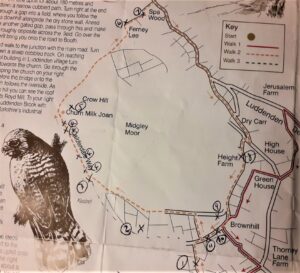
When someone reports a problem we go and inspect it. We decide if we can do it, how long it will take, how many volunteers and what materials and tools will be needed.
Sometimes we walk along a published route to survey its condition, and at the same time we add waymarks where needed.
Feedback to Calderdale Council
We often get reports of deliberate closures or obstructions which we refer to Calderdale Highways.
Three large completed projects
Rough Hey Woods, Ryburn 2025 – Situated above the River Ryburn, these woods are a popular destination for walkers from Sowerby Bridge, Barkisland and Ripponden. The 4-5 km of public footpaths were tired and desperately in need of maintenance and improvement. With the help of a generous donation from a local family, CROWS have been able to renew 5 stiles, improve the drainage, clear access by removing overgrowth, repair/rebuild steps, construct boardwalks, install lengths of revetment and upgrade the waymarking. What were rather neglected, difficult paths now offer pleasant, safer, woodland walking.
Langfield Common Boardwalks 2025 – The Common is a glorious place to walk on the exposed moors high above Todmorden and towards Gaddings Dam, Stoodley Pike and Withens Clough. However, in places even flagged footpaths between Warland and Gaddings have sunk completely into the bog, leaving wide areas of erosion, and wet, treacherous walking conditions either side of the route. We talked with the Langfield Commoners and agreed a plan of action to install two bridging boardwalks to get walkers safely across the worst stretches. We are grateful to the Commoners for their practical help getting materials to the site and to United Utilities for allowing us to access the reservoir tracks to get our materials close to the work site. Most of the funding for these two boardwalks/bridges has come from Calderdale Highways.
Work for Active Calderdale 2025 – Active Calderdale has been working with the communities in Cornholme and Portsmouth to, amongst other things, increase easy access to the countryside for all residents. We have supported this by building a series of boardwalks over very muddy and slippery paths; by widening new footpaths; by improving way-marking to give people confidence on the routes they are following; and by putting in revetments on the steeper sections of the new pathways. We have built some small benches too, to encourage people to walk along the newly designated rights of way and to enjoy the views. CROWS have also worked with Vale Walkers to develop and print new walks leaflets for the area. These were also funded by Active Calderdale.
More information about what we do
We have a more detailed blog of photos and information, which is completed after each of our work parties.
We have also produced a small brochure that describes CROWS, what it does and how it works. You can download the CROWS Brochure here.
You can see our latest Annual Review here.